

From ERP to Orchestration
How are your operational platforms enabling you for the future?
The New Battleground for the Autonomous Enterprise
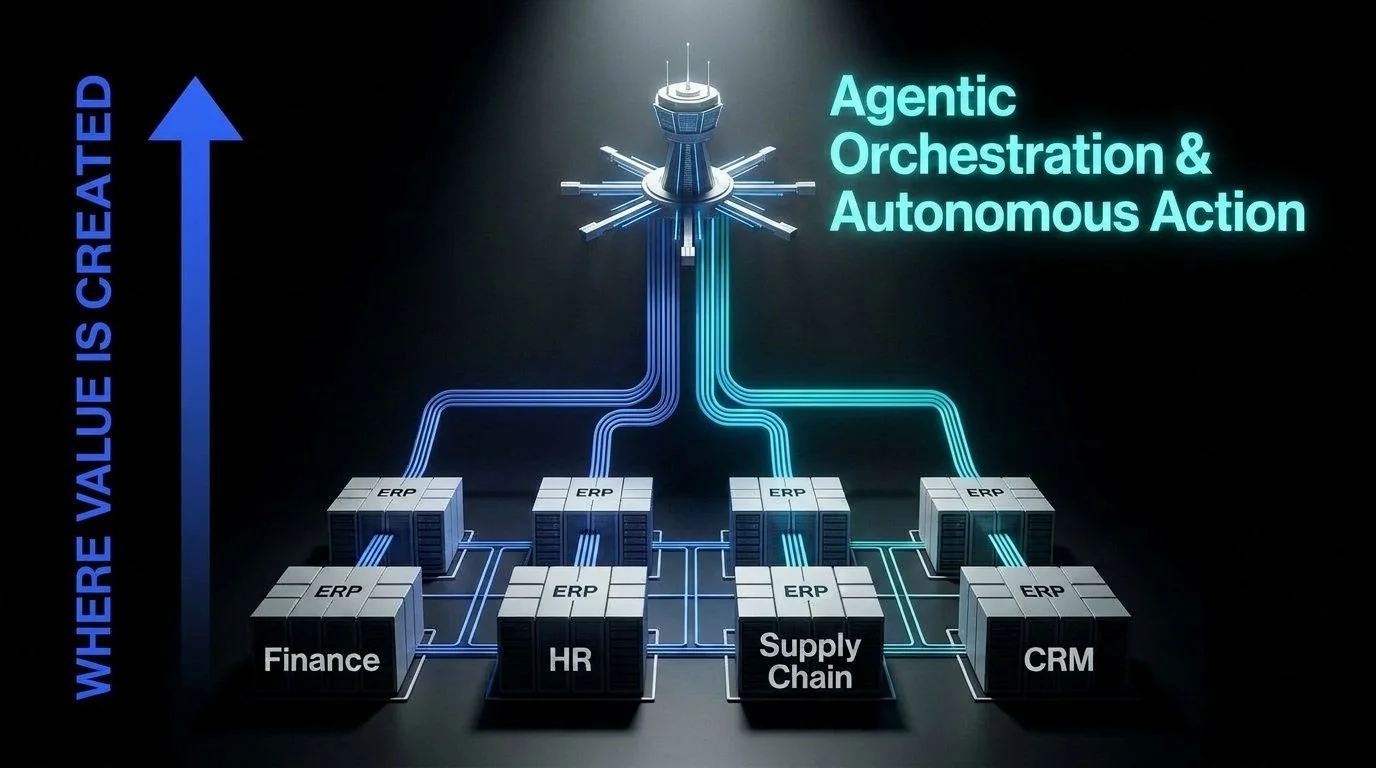
Value creation is shifting to the semantic layers above, where agents act
I recently had the opportunity to talk to Susan Galberaith, a software go-to-market leader.
Together in this article, we explain why ERP is no longer the center of the enterprise: it’s becoming a transactional core, an execution sublayer. Still necessary, but value creation is shifting to the semantic layers above, where agents act.
That statement will likely trigger debate. We want that. What’s unfolding isn’t an incremental evolution. It’s a structural shift in enterprise architecture driven by agentic AI and the emergence of the autonomous enterprise. We want your perspective. What do you think replaces ERP in the autonomous enterprise? How do you believe the enterprise tech stack needs to change with AI agents?
The Stack Is Flipping: From Systems of Record to Systems of Action
For decades, ERP systems dominated enterprise architecture as systems of record: trusted, structured, and auditable. That role isn’t going away. ERP remains “the system of record for trusted data, auditability, and standardized processes,” but according to AI leaders Jim Rowan (Principal, US Head of AI), Vadhi Narasimhamurti (Principal, Global SAP Leader), and Chris Pingel (Principal, Digital Transformation) at Deloitte the vale of the ERP is evolving (Lean, composable, and agile: How ERP is evolving in the agentic AI era).”
Systems of record are no longer where value is created. They’re where value is stored. The new value layer sits above: agentic orchestration layers, an execution fabric where AI agents coordinate processes across systems, data, and humans. In Engineering the agentic enterprise, Deloitte describes this shift clearly: autonomous agents can “coordinate workflows, make decisions, and act with human guidance and oversight.”
This isn’t automation 2.0. It’s a redefinition of how work gets done.
Work is no longer linear; it’s continuously orchestrated.
Decisions are no longer human-triggered. Machines initiate them.
Systems aren’t endpoints anymore. They’re participants.
UiPath and Deloitte expanded their alliance built on this shift (UiPath Expands Strategic Alliance with Deloitte to Launch Agentic ERP). As these firms frame it, enterprises are moving “from task automation to end-to-end process orchestration” across humans, agents, and systems.
The Data Problem No One Can Ignore
The biggest implication isn’t AI, it’s data architecture. Most current enterprise data stacks were built for humans: dashboards, reports, and scheduled queries as the analytical foundation. But agentic systems don’t read dashboards. They act. That’s why the data stack is being rebuilt into what Google calls a “System of Action (The shift to the System of Action: Architecting the Agentic Data Cloud),” where data platforms support “always-on, high-velocity, and autonomous operations.” This requires three shifts:
From data to knowledge: Agents need semantic context, not just fields and tables.
From batch to real-time: Decisions happen in milliseconds, not reporting cycles.
From governance after the fact to governance by design: Autonomous decisions must be explainable, auditable, and constrained in real time.
KPMG puts a number on the challenge: “64% of leaders expect data quality to be their biggest issue in scaling AI,” and the issue is so prevalent that KPMG and Oracle expanded their relationship to build custom agents on OCI and Oracle AI Agent Studio for use with Fusion Applications to accelerate customer AI adoption (KPMG Accelerates Agentic AI and Enhances Enterprise Data Solutions with Oracle).” At Sapphire SAP also unveiled the Autonomous Enterprise (SAP Unveils the Autonomous Enterprise) an SAP Business AI Platform that deepened partnerships with Anthropic, Amazon Web Services, Google Cloud, Microsoft, NVIDIA, and Palantir. We’ll be blunt: you can’t run an autonomous enterprise on a fragmented data foundation.
The Rise of the Agentic Enterprise
The concept of the Agentic Enterprise (The Agentic Enterprise) reframes the conversation. Leading organizations aren’t deploying more tools. As Tenger Ways founder Daniel Keith puts it, “they’re rethinking where work actually happens.” In this model:
Agents don’t live in systems. They live in workflows.
Intelligence isn’t something you access; it’s embedded in the work.
Work isn’t searched for. It’s surfaced and executed.
Or, as MIT Sloan and BCG note, in agentic systems blur the line between tools and workers, operating as “autonomous teammates…capable of executing multistep processes and adapting as they go (The Emerging Agentic Enterprise: How Leaders Must Navigate a New Age of AI).” This is where the traditional ERP-centric mindset breaks down.
Two Incompatible Architectures
ERP Architecture
Structured Processes
Human-driven Execution
Pre-defined Workflows
Agentic Enterprise Architecture
Dynamic Processes
AI-driven Execution
Continuous Orchestration
The two models can’t coexist unless ERP evolves into a modular, API-driven core within a broader orchestration architecture. That’s exactly where the market is heading.
How Do Leaders Modernize Enterprise Architecture?
If ERP is no longer the system where work happens, why are we still designing our enterprise architecture as if it is? Most CIOs and CTOs are still investing in ERP transformation, data lake modernization, and AI pilots. Few are designing around orchestration as the primary design principle. That’s the gap. Daniel explains why it persists: “It requires reinventing the operating model: embedding intelligence directly into how work gets done, not just deploying more tools. Most organizations aren’t prepared for that. Data management, workflows, and visibility across governance structures are still a challenge.” Closing that gap is the real modernization work.
Five Ways to Start the Shift to an Autonomous Enterprise
Redesign Your Architecture Around Orchestration - Move from application-centric to workflow-centric design. Treat orchestration layers, not ERP, as the control plane of your enterprise.
Modernize Data into an Agent-Ready Foundation - Invest in semantic layers, master data consistency, and real-time data pipelines. Your agents are only as effective as the data they can trust.
Build an Agent Governance Model Early - Define identity, permissions, auditability, and decision accountability now, before agents scale.
Collapse Tool Sprawl into Intelligent Work Hubs - Embed agents into existing work environments where there are opportunities to reduce workflow friction and drive adoption.
Shift Your KPI Model to “Return on Autonomy” - Measure not just AI automation, but how much of your business can operate independently with trust and control.
Agentic AI isn’t just changing the tech stack. It’s redefining how the enterprise operates, down to decision rights, process ownership, and organization structure. The winners won’t be those who implement AI the fastest. They’ll be those who modernize enterprise architecture to take advantage of AI at scale.
We’re interested in your opinion. How do you see AI impacting enterprise architecture?
Want to learn more?
Tenger Ways helps with all of your needs across the IT Operations space. We’re your strategic partner with world-class technical chops. Most importantly, we hang our hats on using modern practices, such as “continuous everything” and “bring joy to the workplace” to help you realize business value faster and with happier team members and more satisfied clients. It’s not just hyperbole! Reach out and let us show you how Tenger Ways is vastly different.